Live Local Act to provide millions in affordable housing across Florida

Governor Ron DeSantis signed the Live Local Act yesterday, promising millions in affordable housing funds and preempting local restrictions.

Housing in Florida is a well-known and difficult issue for residents to navigate. As the state’s population continues to grow, fuelled by deep-pocket individuals from California, New York, Illinois and other high-tax states, housing prices and rental rates alike have soared over the last few years. Consequently, affordable housing has become a rallying cry for local officials, community leaders, and everyday Floridians. Now, the Live Local Act promises relief – but developers will need to make full use of what the bill offers for it to work.

“When I moved here to Naples almost 43 years ago, the community was talking about the lack of housing for our workers,” said Senate President Kathleen Passidomo, who the Governor credits with shepherding the bill through the legislature. “It was a problem then and remains a persistent problem in many areas of our state – that changes today!”

The bill, formally known as SB 102, provides $711 million in funding for affordable housing projects, low-interest loans, preempts municipalities ability to regulate height and density restrictions, and prevents the implementation of rent controls. According to attorney Keith Poliakoff of the Fort Lauderdale-based Government Law Group, the bill “takes a lot of the handcuffs off” of affordable housing development, reported TheRealDeal.

The bill provides $259 million for the Florida State Apartment Incentive Loan (SAIL) program, which provides low interest loans for workforce housing projects. SHIP – the State Housing Initiative Program, also receives $252 million to incentivize local government partnerships with developers to preserve or build new housing. Both programs are administered by the Florida Housing and Finance Corporation (FHFC).

The FHFC will also receive a one-time $100 million for the creation of a competitive loan program for developers looking to cover inflation-related costs in FHFC approved multifamily projects that have yet to break ground. The funding will likely provide relief as financing certain projects becomes more of an issue as rates continue to rise and lenders pull back. As Roy Faith, senior vice president of investment and development group The Faith Group, explained in an earlier interview with Invest: Miami. “You have to have great relationships with banks and financial institutions as well as with your partners. That is challenging in today’s market. There are a lot of projects that have been delayed right now because of what we are seeing in the market. In the next six months to a year, we will see how the market changes and that will impact many of the deals moving forward,” Faith said.

The bill also codifies the popular Hometown Heroes Housing program, a homeownership assistance program begun last year that allows law enforcement officers, firefighters, educators, healthcare professionals, childcare employees and active military personnel or veterans to receive first time income-qualified down payment and closing cost assistance.

Zoning concerns are also addressed in the bill. What was once a mundane part of the development cycle has become increasingly contentious across the state. Municipalities have been increasingly caught in the middle, attempting to relieve housing costs by upzoning for developers while simultaneously limiting changes to specific, often transit-oriented corridors to placate residents. In some cases, upset residents who oppose higher density and new development have worked and succeeded in making the process as arduous as possible in the hopes of project cancellations.

Under the new law, the decision has been removed from local officials’ hands. For the next 30 years, local governments are now required to allow multifamily or mixed-use residential projects that set aside at least 40% of the residential component for affordable housing. In projects where 65% of the square footage is residential, a county cannot restrict the height of the project to anything less than what’s currently allowed within one mile of the plan. The law also requires local officials to look at reducing parking requirements for projects within a half mile of major transit stops.

While there may be some questions, and no doubt some upset citizens, to emerge over the coming weeks and months as developers, attorneys, and local officials relay the information to their respective stakeholders and adjust to the new reality, the state seems poised to embark on what could be another building boom, even as national economic uncertainty begins to slow demand in some Florida markets.

“Together, we are shutting down affordable housing stereotypes and creating attainable housing options needed by the majority of our workforce, the backbone of Florida’s economy… As our state continues to grow, our Live Local Act will make sure Floridians can live close to good jobs, schools, hospitals, and other critical centers of our communities that fit comfortably in their household budgets, no matter the stage of life or income,” Passidomo said.

The full text of the bill is available here

For more information, visit: 

https://www.flgov.com/

Article Link: Live Local Act to provide millions in affordable housing across Florida
Author: Joshua Andino

Boca Raton: Judge rebukes officials, orders new review of proposed beach house

A federal judge has ordered Boca Raton to reconsider its 2019 denial of a permit to build a home on the beach and barred Mayor Scott Singer and City Council members Andrea O’Rourke and Monica Mayotte from taking part.

U.S. District Judge Rodney Smith excoriated the three officials for bias they showed under oath and said some of their actions were apparent violations of Florida’s Sunshine Law. He saved his strongest words for O’Rourke.

“The record is replete with her bias all over. … Her credibility is totally shot,” Smith said.

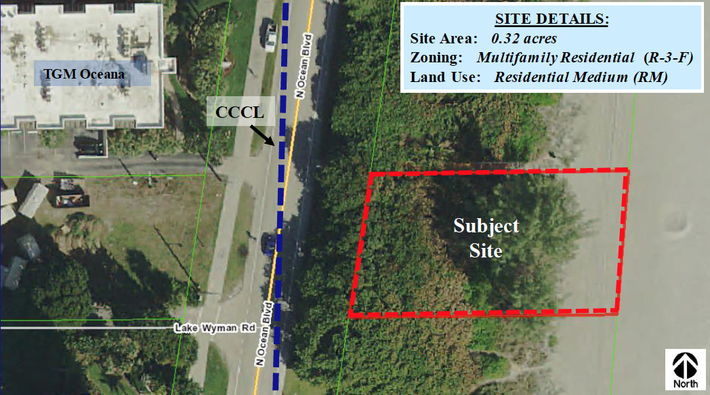
Natural Lands LLC sued the city in federal court, claiming that the vote by Boca Raton’s elected officials stripped its property at 2500 N. Ocean Blvd. of all economically beneficial or productive use. It bought the .34-acre parcel in 2011 for $950,000; its plans for a four-story, single-family home provoked a public outcry.
After a five-day non-jury trial, Smith on March 24 declined to rule the case an unconstitutional taking of land by the city government, saying case law required that the property have no remaining economic value.

The property at 2500 N. Ocean Blvd. will come back to the City Council for consideration. Photo provided

“The emphasis on the word ‘no’ in the text of the opinion was, in fact, reiterated in a footnote,” Smith said, sending the case back to the City Council.

But Smith had little good to say about the three elected officials.

“I can tell you, from the beginning I was somewhat taken aback,” Smith said. “I don’t believe it for one minute that they would even consider being fair and impartial to Natural Lands under any stretch of the imagination at all.”

Singer, he said, was obviously biased and his testimony “made it clear as to his stance — he cannot be a fact-finder and impartial decision-maker in this particular matter.”

Smith found that to be particularly irksome because Singer, who was out of town and testified via video recording, is a lawyer. “He could not even address … what does the term ‘being fair’ mean. He looked at us like a deer in headlamps who was a person, a trained lawyer, that he has never heard of the word ‘fair’ before,” Smith said.

O’Rourke, the judge said, presented “unbelievable” testimony on the witness stand. At one point she “pretended” that she did not know she had been prohibited from voting in the case by the Palm Beach County Circuit Court and the 4th District Court of Appeal, he said.

Mayotte, too, “demonstrated complete bias from the start,” said the judge. “Clearly she had no business casting a decision knowing how she felt.”

Of all three council members, Smith said, “their beliefs were strong to the point where it was stronger than Gorilla Glue as to their bias that no property or nothing would ever be built.”
Smith deviated from the earlier circuit court and 4th DCA rulings in the Coastal Construction Control Line vote, which declared only O’Rourke and Mayotte biased, by tagging Singer as well.
Court documents showed Singer on Aug. 23, 2018, for example, emailed a resident that “Based on the potential impact on our dunes and sea life (including turtles), I will NOT support granting a variance that would be needed to allow the coastal construction for this lot and the proposed home there. My policy has been and still is to protect our beaches and green space.”

Midway through the trial, Smith allowed evidence to be presented on the actions of then-Deputy Mayor Jeremy Rodgers, who is no longer on the council, but did not specifically discuss it while making his ruling.

The Natural Lands lawyers discovered that the city had stipulated in similar litigation involving nearby 2600 N. Ocean Blvd. that Rodgers in August 2017 emailed a resident to say, “I’m of course going to continue going NO on 2500 and likely NO on 2600.”

That case also includes Facebook Messenger exchanges between Rodgers and O’Rourke regarding the beach parcels and Sept. 17, 2018, text messages between O’Rourke and Mayotte, court documents show. Florida’s Sunshine Law prohibits two or more elected officials from discussing issues outside of meetings.

But the end result of the Natural Lands case is that the partnership will again have to submit its application to the city to build seaward of the Coastal Construction Control Line. During the trial, Deputy City Manager George Brown and Development Services Director Brandon Schaad testified that the owner could submit a plan for a smaller house.

And despite their emails in evidence to the contrary, Singer, O’Rourke and Mayotte all testified that they might have approved a smaller structure.

Smith relied on that for his ruling.

“The court does not find that there has been a total taking,” he said, while noting that Natural Lands’ right to build a single-family home on the parcel “is a vested right,” meaning it existed before the partnership bought the property and will stay with the land if Natural Lands sells it to someone else.

Smith’s decision that Singer, O’Rourke, Mayotte and anyone else who was “tainted by them” cannot take part in the reconsideration means three sets of fresh eyes for the application. Term-limited O’Rourke’s last day in office was March 31. Without Singer and Mayotte, the issue will be decided by Yvette Drucker, Fran Nachlas and Marc Wigder, who all took office long after the Natural Lands vote.

Smith also ordered the city to pay Natural Lands’ attorney’s fees and costs.

Gavriel Naim, a Natural Lands partner who sat through the trial, said he needed time to digest Smith’s ruling before commenting on it.

“I won on my right to develop my property,” he said.

Brown, who also sat through the trial as the city’s representative, said only that when Natural Lands resubmits a plan, “We’ll consider it.”

Drawings show LEFT: the side of the building that faces Ocean Boulevard with two driveways and RIGHT: the mostly glass side of the building facing the beach. Renderings provided

Natural Lands planned to build a 48-foot-tall, 8,666-square-foot single-family home at the site and obtained a Notice to Proceed from the state Department of Environmental Protection in October 2016.

The City Council caused a public outcry in December 2015 when it approved a zoning variance at 2500 N. Ocean to allow something to be built on the 88.5-foot-wide lot. City rules normally require lots at least 100 feet wide.

It denied the CCCL variance on July 23, 2019.

Singer did not immediately return a call seeking comment.

Before the trial, the city offered to pay Natural Lands the $950,000 it paid to buy the parcel to drop the case. The partnership declined.

During the trial, Celora Jackson of the state DEP testified that any construction project on the beach would have adverse effects on sea turtles but that her department made sure there were no “significant” adverse impacts before issuing a Notice to Proceed.

Article Link: Boca Raton: Judge rebukes officials, orders new review of proposed beach house
Author: Mary Kate Leming

These bills in the Florida Legislature could have a big effect on Orlando development. Here’s how.

Companion bills making their way through the Florida House and Florida Senate have Paul Owens and others who share concerns about citizens’ ability to push back against development on alert.

The bills are Florida House Bill 359 and Senate Bill 540, which would mandate that those who sue local governments over comprehensive plans or comprehensive plan amendments be on the hook for attorney fees and court costs if the municipality or county being challenged prevails in the matter.

Comprehensive plan amendments are often necessary in the entitlement or approval process for new development, and lawsuits over them are one of the tools available for individuals or groups wishing to prevent or delay such development.

For Owens, a longtime Orlando resident and president of Tallahassee-based 1000 Friends of Florida, a smart-growth advocacy group, these bills are a big deal — and a big problem.

“If this provision becomes law, it will be too risky for citizens or public interest groups like mine, with modest budgets, to take the financial risk of challenging a comprehensive plan amendment,” Owens told Orlando Business Journal. “If the citizens or public interest group loses, then they are on the hook for those legal costs. I’m talking potentially six figures [in legal costs], and there are very few people I can think of who would be willing to take that financial risk.”

Robert Rosen, an attorney and partner in the Orlando office of Burr & Forman, similarly told OBJ that this type of legislation likely will have a chilling effect on challenges — but also could help avert challenges with no merit.

That matters, as well, because such challenges can be used as a tactic to delay projects until the clock runs out on their feasibility, according to attorney Keith Poliakoff of Fort Lauderdale-based Government Law Group.

In an interview with The Real Deal, a New York-based real estate news site, Poliakoff — whose practice has involved representing both municipalities and citizen groups that challenge them in such case — said such delays can take projects past the point of viable.

“Because of the unfortunate slowness of our courts, developers are finding that it can potentially take years before the challenge ever sees a judge or light of day,” Poliakoff said. “That delay causes [developers] to miss the cycle and makes the property no longer desirable to develop.”

In a separate statement sent to on Poliakoff’s behalf to media outlets in Florida, Poliakoff further reinforced the potential chilling effect Rosen alluded to, arguing that since municipalities win these types of cases more than 90% of the time, the risk of incurring such costs would be all the more heightened for those challenging the development.

Related to this set of companion bills is a second set of companion bills — Florida House Bill 843 and Senate Bill 816 — which would require the prevailing party in these types of lawsuits to demonstrate that the litigation was “frivolous” in order to recover those costs.

Meanwhile, the legislation figures to be closely observed in metro Orlando’s commercial real estate community as it moves closer to an outcome.

“Anything that deals with the overarching idea of property rights is something we’re very much interested in,” said Daryl Carter, of Maury L. Carter & Associates, a longtime Orlando land broker. “My opinion is anything that protects property rights is good, and anything that erodes property rights is bad.”

Currently, HB 359 and SB 540 are making their way through the respective committee processes in both the Florida House and Senate. Filed later in the session, HB 843 and SB 816 have both been referred to committee.

The legislation comes at a time when expediting development, particularly housing, is top of mind for many cities and counties in Florida.

Owens said it would be a “false choice” to pit citizen engagement in the development process squarely at odds with the ability to accommodate growth.

“I think there’s plenty of room between where both can be accommodated.”

Similarly, he acknowledged that the type of litigation that might be discouraged by the laws, if enacted, is not the only — or even the main — method for groups to engage in the community planning process. Showing up to government meetings in which comprehensive plan amendments are discussed and speaking up during public comment, so that officials know where the community stands, is also an important tool.

“That isn’t taken away, thank goodness, under this bill,” Owens said. “But it’s still important to have that option [to sue] if the decision makers are not swayed by community opposition that is expressed at these meetings.”

Article Link: These bills in the Florida Legislature could have a big effect on Orlando development. Here’s how.
Author: Steven Ryzewski

Breaking down Florida’s proposed affordable housing legislation

Clockwise from top left: Related Urban’s Albert Milov, Pinnacle Housing’s Tim Wheat, Housing Trust Group’s Dilia, Government Law Group’s Keith Poliakoffv Taborav and Holland & Knight’s Debbie Orshefsky (Illustration by Kevin Rebong for The Real Deal)

Housing bill aims to fill funding gaps that developers statewide face

Florida’s proposed affordable housing legislation, aimed at incentivizing developers with major tax breaks and hundreds of millions of dollars in funding, is advancing in the state legislature.

Senate Bill 102, known as the “Live Local Act,” and related legislation would be a boon for developers of attainable and workforce housing, real estate attorneys and developers say. The bill was approved by the community affairs and appropriations committees in February, and heads to the senate floor next. If it becomes law, it will take effect July 1.

Florida Sen. Alexis Calatayud, a Republican who represents part of Miami-Dade County, introduced the legislation in January. It aims to create more affordable rental housing via tax breaks, expedited permitting, funding and zoning incentives. It also would restore funds to the Sadowski Trust Fund, which has been gutted by Florida lawmakers for years.

Opponents are critical of some aspects of the legislation, including the state eliminating the ability of local governments to enact rent control. That is currently only allowed if local governments declare a housing emergency.

Land use lawyer Debbie Orshefsky, based at Holland & Knight’s Fort Lauderdale office, said it marks the first time Florida takes a “comprehensive approach to addressing the affordable housing crisis.”

More than 2.1 million low-income households in Florida spend more than 30 percent of their incomes on housing, and over half of those households spend more than 50 percent of their incomes on housing, according to the Florida Housing Coalition.

South Florida became one of the least affordable housing markets in the country last year, following large gains in home prices and rents during the pandemic. Miami-Dade County Mayor Daniella Levine Cava declared a housing emergency in April, and later distributed millions of dollars in federal rental assistance funds.

If the proposed legislation passes, local governments would have to maintain an online inventory of affordable housing properties. They would also be required to expedite building permits, which some already do.

The bill also preempts local governments’ zoning, density and height requirements of affordable housing, in areas zoned for commercial or mixed-use development. That means such developments may not require zoning changes or comprehensive plan amendments. Local governments would be required to allow multifamily and mixed-use residential in any commercial or mixed-use zone if at least 40 percent of the residential is affordable for at least 30 years. With projects allocating at least 65 percent of the square footage to residential, a county would not be able to restrict the height of a proposed development below what’s currently allowed within one mile of the planned project.

In addition to providing new sources of funding for low income housing tax credit developers, the legislation “will also allow market-rate rental developers to actually incorporate some affordable units in their market-rate developments,” Orshefsky said.

Market-rate developers who include workforce housing units in their developments could qualify for ad valorem tax exemptions. Developers setting aside at least 70 units for people earning 120 percent of the area median income or less, in newly completed or substantially renovated properties, could qualify.

Orshefsky said that if the bill becomes law, her market-rate developer clients will consider setting aside units for affordable housing.

Tim Wheat, a partner at Miami-based Pinnacle Housing, said the prospect of providing exemptions for developers building units for people earning between 80 percent and 120 percent of the AMI, which he referred to as the “missing middle,” is key. Property taxes could account for 25 percent of a developer’s operating cost on a per-unit basis, he said.

“Now developers that are doing market-rate projects in urban areas are going to look at this potential tax exemption, they’re going to look at their pro formas, and say ‘Hey, maybe that’s worth it for us,’” he said. “It’s a way for the private market to solve a problem there really is no solution for.”

The affordable housing arm of Miami-based Related Group has thousands of units it would finance under the proposed legislation “once it becomes law,” said Albert Milo, president of Related Urban, via a spokesperson. The firm has more than 10,000 units in its development pipeline in Florida.

Also under the bill, local governments can offer property tax exemptions to developers who set aside units for households earning 60 percent of the AMI. Land owned by nonprofits leased for at least 99 years could also receive the property tax exemption.

Increased funds

Attorney Keith Poliakoff, of Fort Lauderdale-based Government Law Group, said the state’s existing affordable housing funds are currently “woefully small, based upon the need.” Florida Housing and Finance Corporation only approved one project in Broward County for 2023, he said. FHFC administers the state’s SAIL (State Apartment Incentive Loan) and SHIP (State Housing Initiatives Programs).

But under the proposed law, the amount of affordable housing funds would grow exponentially.

“This landmark legislation is the first of major consequence to help ensure affordable housing will be built,” Poliakoff said. “It takes a lot of the handcuffs off the developers who develop this type of housing.”

Under the proposed legislation, up to $150 million would be allocated to SAIL; another $109 million from the State Housing Trust Fund would be directed to SAIL; $100 million would go to the Florida Hometown Heroes Program; $252 million to SHIP; and $100 million in non-recurring funds would be set aside for a competitive loan program that developers could tap to cover inflation-related cost increases for FHFC-approved multifamily developments that haven’t broken ground yet.

The legislation also increases the amount of tax credits available through the Community Contribution Tax Credit Program for affordable housing to $25 million annually, from $14.5 million. And it provides up to a $5,000 sales tax refund for building materials used for affordable housing units.

The Hometown Heroes homeownership assistance program, which was created last year, allows some buyers to finance home purchases with no-interest loans to reduce their down payment and closing costs to a maximum of 5 percent or $25,000, whichever is less. Buyers who qualify have a household income of no more than 150 percent of the state or local AMI. The law would codify the program and expand eligibility to more people, according to the Senate’s analysis.

Poliakoff said a number of projects that his developer clients are working on are approved, but are on hold due to funding gaps. The growing cost of construction has also affected affordable housing builders. Wheat, of Pinnacle, said the cost of insurance has gone up as much as 40 percent.

Miami-based Housing Trust Group, led by Matthew Rieger, is missing about $3 million for the second phase of a development in Deerfield Beach called Tallman Pines, said Dilia Tabora, HTG’s vice president of development. The Broward County Housing Authority has been trying to redevelop the site for years. HTG also has a 320-unit planned development in Naranja Lakes near Homestead. The developer is looking to secure about $4 million in funds to move forward on the project.

“We have funding, but with the construction costs and the insurance costs you never know if it’s going to end up where it will,” she said. The property tax exemption, Tabora added, would be “insanely helpful” for developers.

Article Link: Breaking down Florida’s proposed affordable housing legislation
Auther: Katherine Kallergis

Hollywood paving way for three 25-story towers, four-story hotel on public golf course

HOLLYWOOD — Here’s what’s on the menu for Hollywood’s Orangebrook Golf Course: A redesign by legendary golf course designer Rees Jones; a four-star, four-story hotel with 175-rooms; and three 25-story towers with 750 apartments.

A local developer beat out two other suitors Wednesday vying for the chance to redesign Hollywood’s public fairway, ensuring the city won’t need to use $25 million from a voter-approved parks bond to spruce up the greens.

In a 4-3 vote, Hollywood commissioners ranked the suitors they want to take to the dance, as Mayor Josh Levy put it in an interview this week with the South Florida Sun Sentinel.

GCF Development/PPG Development, led by Hollywood builders Chip Abele and Ari Pearl, got the top ranking followed by Maitland-based E2L Real Estate Solutions in second place and Jupiter-based Ernie Els Group in third. A fourth firm, Green Lynx, withdrew from the competition just days ago.

The vote came after a spirited debate that lasted more than three hours and had one woman fighting back tears while she implored the commission to reject plans to build a hotel and high-rise towers on taxpayer-owned land.

The controversial project involves a 99-year lease of public land to pave the way for the hotel and high-rise towers — a prospect that has elicited protests from critics who don’t want to see the historic course developed.

Elmyra Powell, who lives one block from the mammoth 260-acre golf course, is one of those critics.

“Once again, I’m standing here before you asking you to represent the people’s interests,” Powell told the commission, her voice soon trembling with emotion. “We asked you to look out for our little golf course that was dying a slow death. You’re talking about our heart when you talk about that golf course. We want to save Orangebrook. We don’t want you to give us a new country club resort.”

A golfer tees off at Orangebrook Golf Course in Hollywood on Tuesday. (Amy Beth Bennett/South Florida Sun Sentinel)

A no-brainer

But fans called the plan a no-brainer, saying the redesign will help make Hollywood a golfing destination and might even bring a PGA tournament to town.

The plan calls for two public full-size 18-hole courses, a 34,000-square-foot clubhouse with a restaurant, a pro shop and driving range, fitness facility, banquet hall, lighted nine-hole practice course and a 3-mile walking trail.

The project — an investment that the builders say exceeds $400 million — will also add to the city’s bottom line. The developer has offered Hollywood a 50/50 split of the profits from the golf course and clubhouse. In 30 years alone, the GCF/PPG project is expected to add $152.4 million to Hollywood coffers.

One resident asked how the city got to this point.

Here’s the answer: In July 2020, Hollywood got an unsolicited proposal from Green Lynx to redevelop Orangebrook. As required by state law, the city solicited additional proposals for a public-private partnership, commonly known as P3s.

Four teams submitted bids by the October deadline and were later ranked by an evaluation committee made up of city staff. But the commission has final say.

Longtime resident Ann Ralston fumed over the fact the parks bond approved in 2019 made no mention of a hotel or apartment towers at Orangebrook.

“I would like to know where this money is,” she told the commission. “It’s been four years and I’m paying for [the bond]. Now I’m paying for something that’s not getting done. Never again. If you people think you’re going to pass a bond in the city to do a bait-and-switch, it’s going to be over my dead body.”

Hollywood plans to use the millions that were slated for Orangebrook on other parks projects throughout the city.

The mayor had reassuring words for commissioners before they cast their votes on Wednesday.

“Today is not a marriage,” Levy said. “As things get fine tuned, there can be improvements and changes [to the initial proposal]. If we can’t reach terms with the number one team, we go to team number two and team number three.”

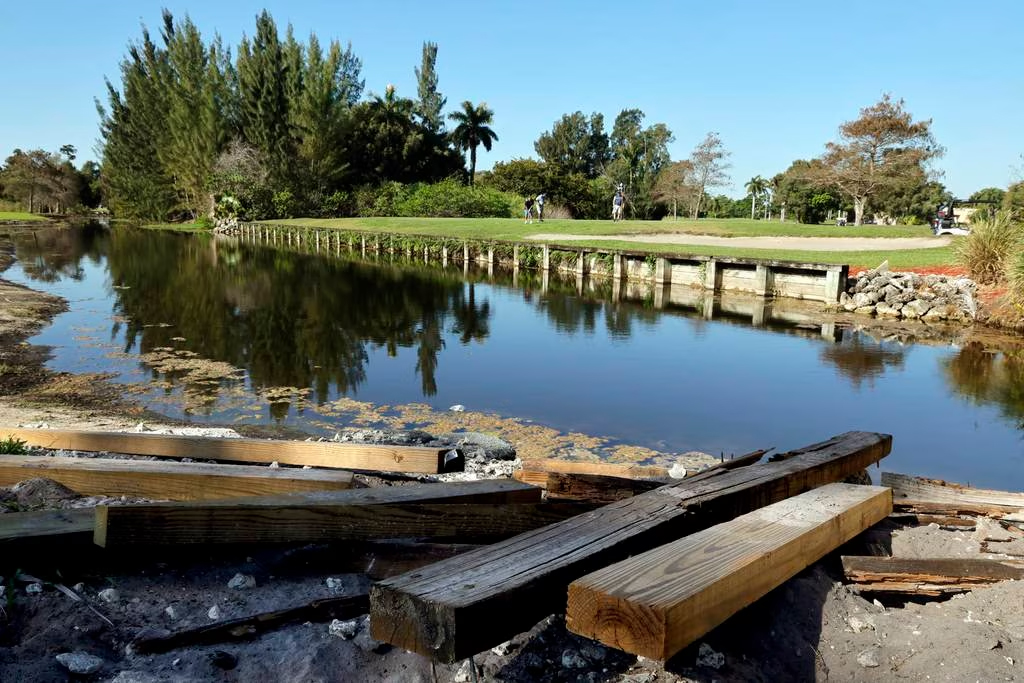
Rotten and damaged boards are shown at Orangebrook Golf Course on Tuesday. (Amy Beth Bennett/South Florida Sun Sentinel)

Seal the deal

In June, the commission is expected to vote on a comprehensive agreement that will seal the deal.

If all goes as planned, the golf course will break ground in the beginning of 2024 and open 18 months later, said Keith Poliakoff, attorney for the developers. The clubhouse and golf course amenities would open six months later.

And the trio of apartment towers will take about five years to complete.

To sweeten the deal, the developer offered to set aside 100 apartments for affordable and workforce housing — or about 13 percent of the entire project.

The hotel and apartment towers will take up less than 5 acres of the golf course, Poliakoff said.

The developers have tapped Rees Jones to design the course.

Jones has designed or redesigned more than 250 golf courses in his career, including some of the most well-known public courses in the world, the developers said in their pitch to the city.

Jones designed Torrey Pines, known as one the best golf courses in California with two 18-hole championship courses. Torrey Pines played host to the U.S. Open in 2008 and 2021.

He also designed Bethpage Black on Long Island. The course hosted the PGA Tour in 2011 and the PGA Championship in 2019.

Jones, who spent more than three hours watching the debate from the audience, drew praise from the mayor for attending the meeting.

“A PGA tournament will come here if we have a sponsor,” Jones told the commission. “I think there is an opportunity to have a tournament. [But] we’re really building this for the people of Hollywood. This is my love, the public golf course.”

Susannah Bryan can be reached at sbryan@sunsentinel.com or on Twitter @Susannah_Bryan

Article Link: Hollywood paving way for three 25-story towers, four-story hotel on public golf course
Author: Susannah Bryan

Secured Media Opportunity: DBR on North Palm Beach Win

Ares pays $28M for Boca Logistics Center

Deal marks at least second industrial purchase by investment management firm in as many months.

Ares Management scooped up the newly built Boca Logistics Center for $27.8 million, marking the investment firm’s continued appetite for South Florida real estate.

Ares bought the two warehouses at 644-646 Park of Commerce Way in Boca Raton from the property’s developer, McCraney Property Company, according to records and real estate database Vizzda.

McCraney Property had paid $7.5 million for the 8.7-acre development site in 2019. It completed the two buildings that span a combined 119,000 square feet between late last year and early this year, records show. McCraney is an industrial and office-flex real estate developer and manager, its website says. Led by founder Steven McCraney, the firm has offices in West Palm Beach, Orlando and Charlotte.

The deal, which breaks down to $233 per square foot, marks Ares’ second industrial purchase in South Florida in as many months.

In January, the global investment manager’s Ares Industrial Real Estate Income Trust paid $111.1 million for 52 acres of developable land at Countyline Corporate Park in Hialeah. Ares plans a pair of industrial buildings, each spanning 214,000 square feet, and a third building spanning 193,000 square feet, on the northwest corner of Northwest 154th Street and West 40th Avenue, records show.

The Los Angeles-based investment firm’s bet on South Florida has extended to the David Beckham-backed Major League Soccer team Inter Miami CF. In 2021, Ares, through funds managed by Credit Group, made a $150 million preferred equity investment in the team.

Led by Michael Arougheti, Ares was founded in 1997 and has $352 billion in assets under management, according to its website. Arougheti co-founded the publicly traded firm with Antony Ressler, David Kaplan and Bennett Rosenthal.

South Florida’s industrial market slowed in the fourth quarter, compared to a leasing frenzy of the past two years. Palm Beach County’s industrial vacancy rate increased to 5.1 percent, from 4.1 percent, year-over-year, according to Newmark. The county also recorded a negative absorption of nearly 102,000 square feet. And the average asking rent dropped to $12.66 a square foot, from $13.07 a foot in the third quarter.

Article Link: Ares pays $28M for Boca Logistics Center
Auther: Lidia Dinkova

Florida Restaurant Wins $3.2M In Eminent Domain Dispute

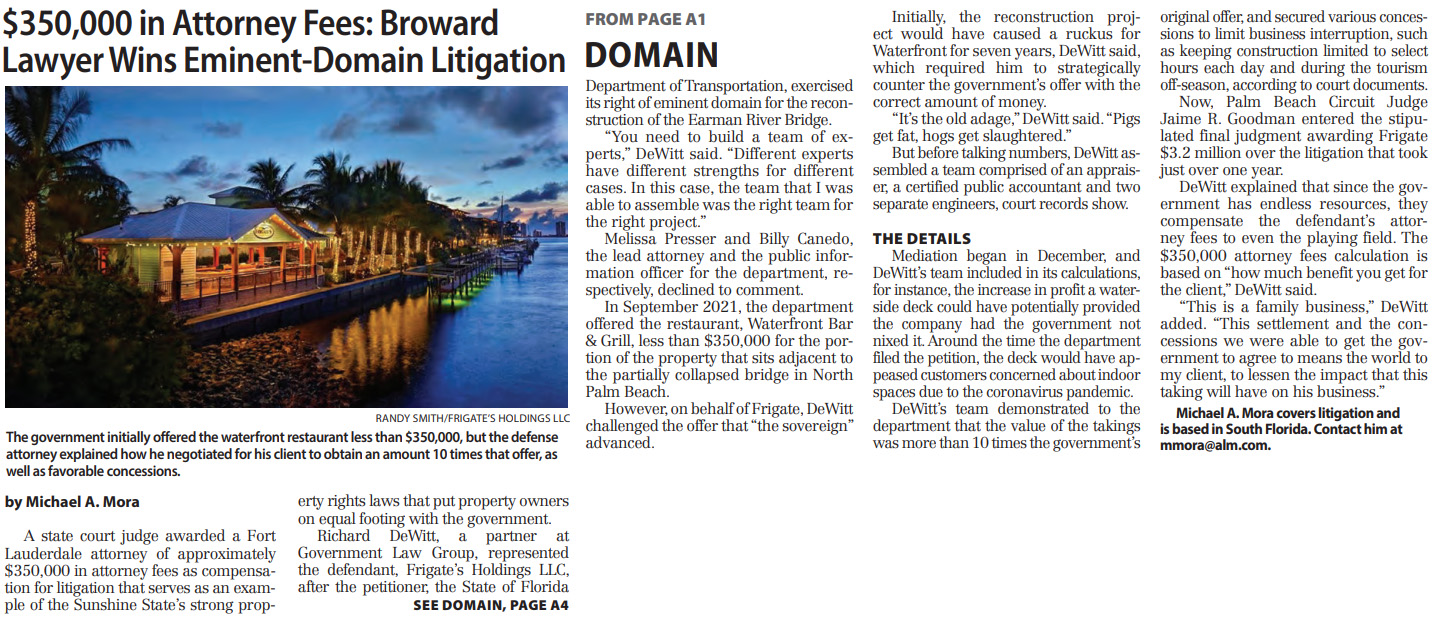
A Florida state judge awarded $3.2 million as compensation to a Palm Beach County restaurant that was sued by the state’s Department of Transportation under the state’s eminent domain laws so that the government could obtain land to rebuild the Earman River Bridge after it partially collapsed in 2017.

In his order filed Tuesday, Judge Jaimie R. Goodman of the 15th Judicial Circuit Court noted that the department had previously deposited $346,100 in the court registry, and told the department to send a $2.8 million check to Frigate’s Waterfront Bar & Grill Inc.’s counsel within 60 days of receiving his court order.

Florida’s government began its suit against Frigate’s Waterfront Bar & Grill in September 2021 in Florida state court. According to a public relations representative for Government Law Group PLLC, the law firm representing the restaurant, the department initially offered $346,000 for the restaurant’s land, which was near the reconstruction site of the partially collapsed bridge.

The representative said the reconstruction project would have disrupted the restaurant’s business for seven years.

After the suit was filed, the department and the restaurant began to mediate in December 2022 and settled the dispute in January 2023, according to court records.

In a Wednesday statement to Law360, the restaurant’s counsel, Richard J. Dewitt III described the compensation award as a “stellar result.” Dewitt said that he had to use eminent domain experts to determine how much compensation the restaurant deserved for its land.

Dewitt also praised the professionalism of one of the department’s counsel, Melissa Presser.

“Ms. Presser had an extremely difficult job balancing the needs of FDOT to take the property, the impact to the property and business owner, and protecting the taxpayers dollars in fully compensating the property and business owner,” Dewitt said. “The ultimate result was a great win for Frigate’s which will provide relief to the impacts caused by the Earman Bridge replacement project.”

Counsel for the department didn’t respond to a request for comment Wednesday.

The Department of Transportation is represented by David R. Ottey, Jared Silver and Melissa Presser.

Frigate’s Waterfront Bar & Grill is represented by Richard J. Dewitt III of Government Law Group PLLC.

The case is State of Florida Department of Transportation v. Frigate’s Holdings LLC, case number 50-2021-CA-010519-XXXX-MB, in the Circuit Court of the 15th Judicial Circuit in and for Palm Beach County, Florida.

–Editing by Marygrace Anderson.

Update: This story has been updated with comment from counsel for Frigate’s.

Article Link: Florida Restaurant Wins $3.2M In Eminent Domain Dispute
Auther: Isaac Monterose

New bill would make it riskier to sue to protect undeveloped lands

Floridians would be on the hook to pay when they lose lawsuits that oppose building new homes on undeveloped lands, under a newly filed bill.

Environmental groups fear that if the bill were to pass, it would deter people from filing lawsuits limiting development — and lead to greater sprawl.

“The intent of the legislation seems to be to chill people from filing these sorts of challenges,” said Gil Smart, Policy Director for the Friends of the Everglades. “These are often situations that are controversial — development is such a huge issue statewide.”

State Rep. Wyman Duggan, R-Jacksonville, recently filed the bill, which puts people on the hook financially if they lose such legal challenges to local government’s growth plans, or amendments to those plans.

Through the years, many communities across Florida have enacted protections to preserve undeveloped land and agriculture.

For example, some Florida counties, including Palm Beach County, have comprehensive plans that include agricultural reserves. If local governments were to amend their plans at the behest of a developer to allow a new big-box store or housing, and a person sues over that amendment and loses, that person must pay the county’s legal bills.

Conversely, if the resident is successful in court, the local government is responsible for the plaintiff’s legal costs.

Rep. Duggan’s office did not reply to requests for comment.

Keith Poliakoff, a land-use expert with the Government Law Group of Fort Lauderdale, represents both municipalities and those who challenge them. “Municipalities win 99% of these types of cases,” he said, “because Florida judges typically take the position that a municipality should be able to run itself and have the right to make decisions about their land-use future.”

In other words, people challenging a development would likely have to pay legal fees, he said.

“What this statutory scheme does is it prevents an aggrieved party from having their argument heard, because they’ll be fearful that they’ll be paying the municipalities’ legal fees. So this regulation is probably created by the development community to thwart appeals of land-use changes.”

Appeals delay developments until the land-use challenge is finally heard by a court, which Poliakoff says could take a year or even two after the filing. “A developer would love this bill because they would hope it would prevent someone from appealing.”

“I believe this will have a chilling effect on individuals being able to challenge perceived wrongs that they would like a secondary party to review. It will thwart challenges where a municipality may be overzealous in an action it’s taking. It basically gives a municipality the green light to make changes to its comp plan without fear that they’ll be challenged.”

“I have two or three orders going on right now that if this [legislation] was passed, it would have made my clients think twice about challenging a municipality’s actions.”

The newly filed bill comes as housing is in sharp demand. Broward, Palm Beach and Miami-Dade counties are all facing housing shortages, and all have different lingo for the open land within their comprehensive plans, their guides for growth and land preservation.

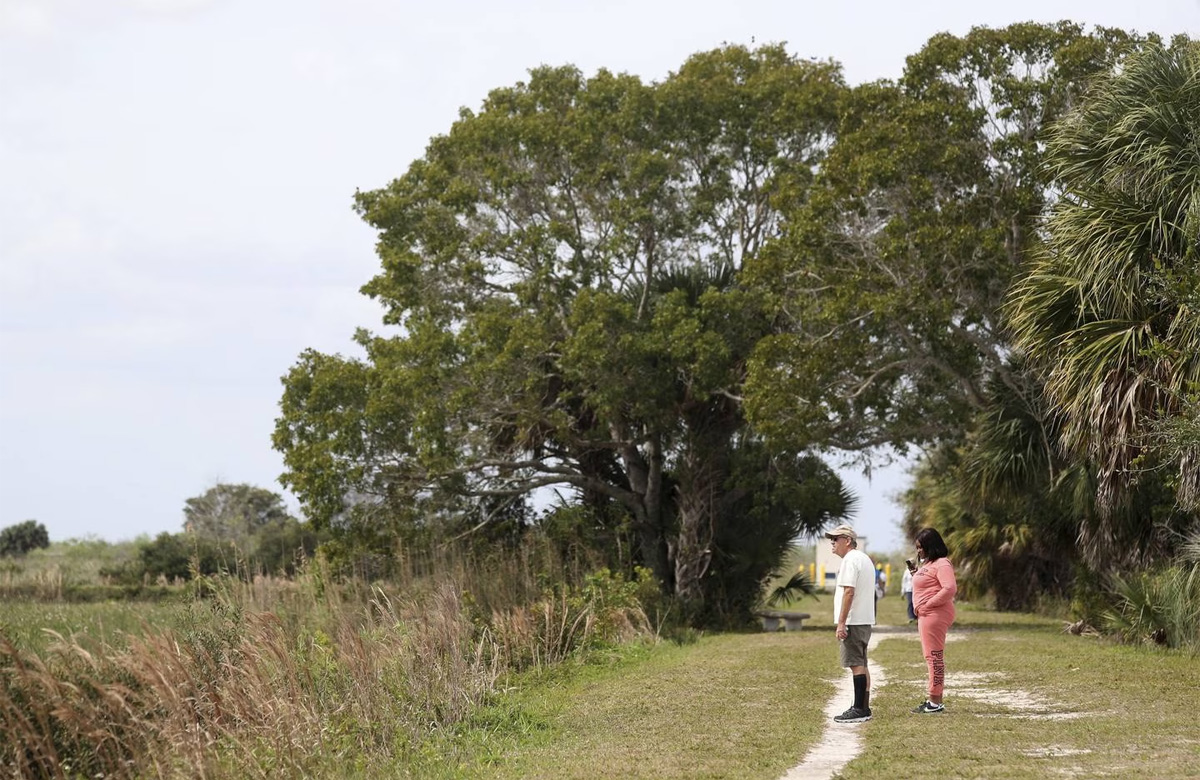
Visitors walk along the Marsh Trail at the Arthur R. Marshall Loxahatchee National Wildlife Refuge. The trail abuts Palm Beach County’s Agricultural Reserve, a nearly 21,000-acre area that the county says is meant to preserve unique farmland and wetlands. (Susan Stocker / South Florida Sun Sentinel)

In 1999, Palm Beach County voters created a nearly 21,000-acre Agricultural Reserve between the turnpike and the Loxahatchee National Wildlife Refuge.

The county’s website says that the purpose of the reserve is to “preserve unique farmland and wetlands” to enhance agriculture, environmental and water resources, and open space, by limiting the use to agriculture, conservation and low-density residential development.

Some developments within the reserve have involved land swaps. One such development proposal by GL Homes looks to expand from an approved 277 homes to 704 homes — the Palm Beach County commission will revisit the issue in May.

In order to build the homes, the county would need to approve a land swap in which GL Homes trades 1,600 acres in Loxahatchee to the county for the rights to build in the Agricultural Reserve.

Broward County does not have an agricultural reserve, but does have a thin band of agricultural land in the southwest corner.

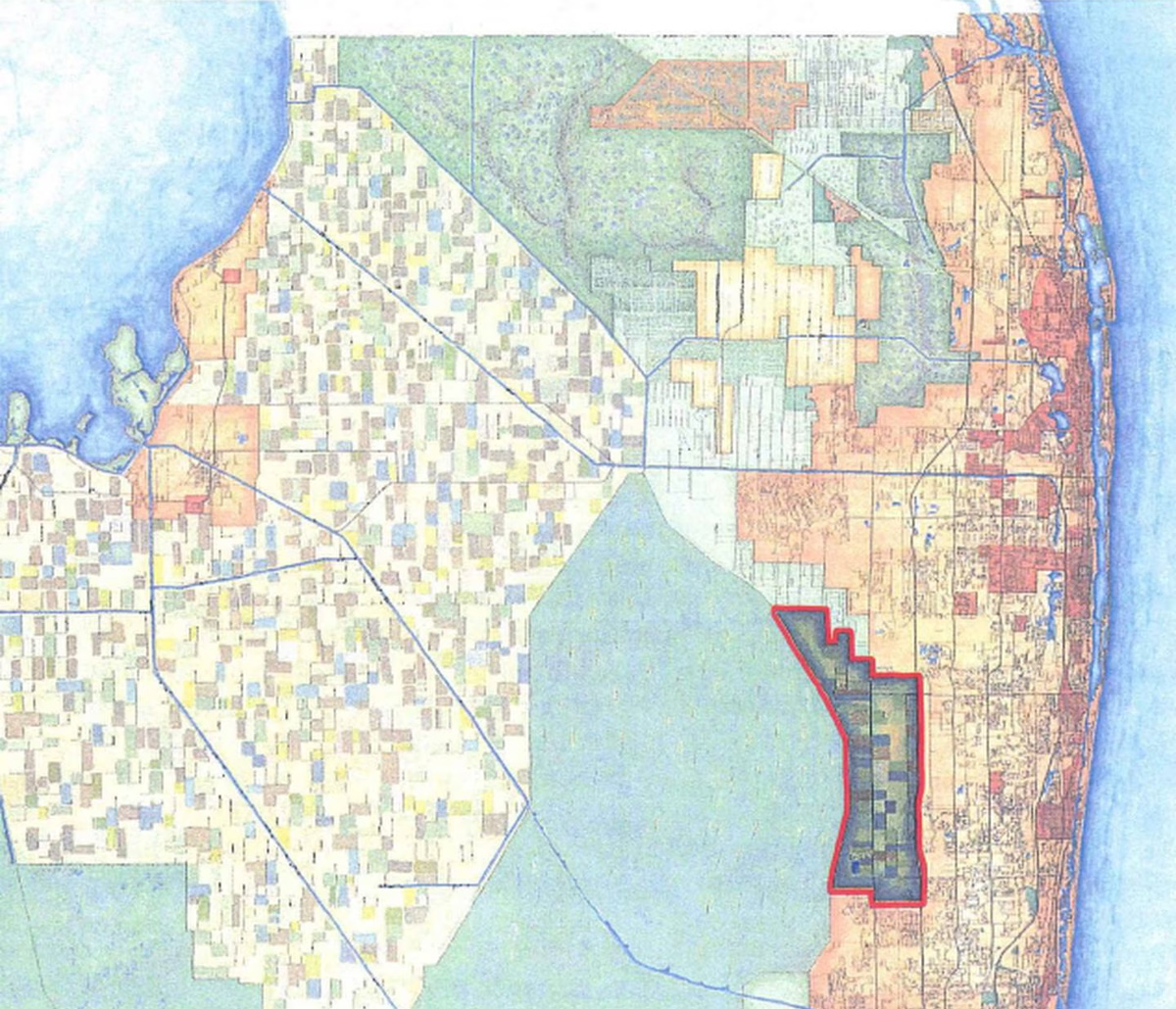
Palm Beach County’s Agricultural Reserve, in red, was established in 1999, and maintains open space and farmland adjacent to wilderness and Everglades water treatment areas. A proposed bill would make it more financially risky for citizens to sue to stop development in lands such as the Agricultural Reserve. (Palm Beach County/SFWMD)

Miami-Dade County recently experienced controversy over an industrial complex slated to go up on farmland beyond the county’s Urban Development Boundary.

The County Commission approved the project, despite the fact that the land had been targeted for Everglades restoration. Last Thursday, the Miami Herald reported that Florida’s Department of Economic Opportunity notified the county that it had fouled up the approval process, and that a re-vote — with a new commission — might be needed.

“There’s a lot of pressure on communities in Florida, and comprehensive plans are out there to help guide growth,” Smart said. “But when you change the plans at the behest of developers, people are going to have a problem with that. Our view is that they should be able to engage in the process without retribution.”

Environmental groups see the new bill as an extension of a 2019 bill, which established that if people sue to stop a development order and lose, they must pay the prevailing party’s court costs.

“Our concern is that this sort of thing is going to enable more sprawl, and more haphazard development, which is going to impact water and the environment in general,” Smart said. “In places like Miami-Dade County … it could have an impact on the footprint of Everglades restoration.”

The bill would have to go through three committees before going to a vote during the March legislative session, Smart said. A companion Senate bill has not yet been filed.

Article Link: New bill would make it riskier to sue to protect undeveloped lands
Auther: Bill Kearney

Government Law Group Adds Attorney Julieta Gomez De Mello To Litigation Team

Julieta Gomez De Mello

Government Law Group is excited to announce that attorney Julieta Gomez de Mello has joined the firm as Senior Associate. She will concentrate her practice on complex commercial litigation representing businesses and individuals in a variety of litigation matters, business litigation, appellate practice, Intellectual Property and Probate Litigation. The addition of Ms. Gomez de Mello expands Government Law Group’s growing commercial litigation practice.

Ms. Gomez De Mello’s experience includes litigating cases involving General Litigation, Employment Law, Professional Liability, Premises Liability, Immigration, Intellectual Property and Personal Injury. Prior to joining Government Law Group, she worked at prominent law firms in New Jersey and Florida successfully litigating complex commercial litigation and high-exposure cases for large corporate clients. In addition to working in the private sector, Ms. Gomez De Mello worked as a Staff Attorney for South Jersey Legal Services, Inc., a non-profit organization based in New Jersey in their Migrant Farmworker Unit handling wage and labor disputes. She also clerked for the Honorable Rodney Cunningham in the New Jersey Superior Court, Atlantic County.

“Julieta is detail-oriented and commits herself to the highest standard of professionalism on behalf of her clients,” said Keith Poliakoff, Co-Founder of Government Law Group. “Julieta will play an important role as we continue to strategically grow and expand our litigation services that we provide to our clients. Julieta is a great asset for the Government Law Group.”

Founded by veteran attorneys Keith Poliakoff and Neil Schiller, Government Law Group offers its clients unparalleled comprehensive service in land use, lobbying, government contracts, commercial litigation, corporate counseling and municipal representation. The firm has offices in Ft. Lauderdale and West Palm Beach and provides clients with highly personalized services to determine the best legal strategy to accomplish their goals. Since the firm was founded in 2021, the Government Law Group has greatly expanded its commercial litigation services.

A Cuban native raised in Miami, Ms. Gomez de Mello is a member of the Florida Bar and New Jersey Bar. She earned her J.D. from Rutgers University School of Law, where she competed in a national Moot Court competition, served as the Vice President of the Rutgers Intellectual Property Law Clinic and was the recipient of several prestigious scholarships, including the Chief Judge Helen W. Nies Intellectual Property Law Scholarship. She completed her undergraduate studies at Florida International University, where she graduated with a bachelor’s degree in English Literature, a minor in music and a Certificate in Translation Studies.

“I was drawn to Government Law Group because the attorneys are highly respected by their peers, are involved in the community and, in several instances, their creative litigation strategies have reshaped the legal landscape,” said Ms. Gomez de Mello. “I look forward to bringing my skills and experience to a seasoned team of litigators to further diversify the services GLG has to offer.”

Article Link: https://www.citybiz.co/article/372343/government-law-group-adds-attorney-julieta-gomez-de-mello-to-litigation-team/