As a luxury sports bar seeks later hours in Delray Beach, it gets caught in noise battle with neighbors

DELRAY BEACH — The issue of whether more late-night bars in Delray Beach could expand farther out on Atlantic Avenue will likely soon come before the city again as a new sports bar keeps up its fight to receive an exemption to stay open until 2 a.m.

And that will likely set up another contentious battle between business owners who want the freedom to operate later and residents who bought homes outside the city’s entertainment district concerned about late-night noise infiltrating their neighborhoods.

Bounce Sporting Club, an upscale sports bar set for the $300 million Atlantic Crossing development on Atlantic just east of Federal Highway, is planning to open in the fall as one of the cornerstones of the new development. The bar, however, sits outside the city’s entertainment district, which runs from Swinton to Federal Highway and allows businesses to stay open until 2 a.m.

That means Bounce would have to close every night at 12 a.m. unless it’s granted an exemption from the city. Bounce says closing at midnight would significantly hinder its business since so many late-night sporting events such as UFC, boxing and West Coast sports last well past that cut-off point.

Bounce narrowly received preliminary approval from the Planning and Zoning Board, but was forced to temporarily pull its application from a Feb. 1 City Commission meeting after significant backlash from local residents about late-night noise issues made it unlikely the proposal would be granted.

Attorney Neil Schiller, who represents Bounce, said they pulled their proposal so they could “educate” more nearby residents about the bar.

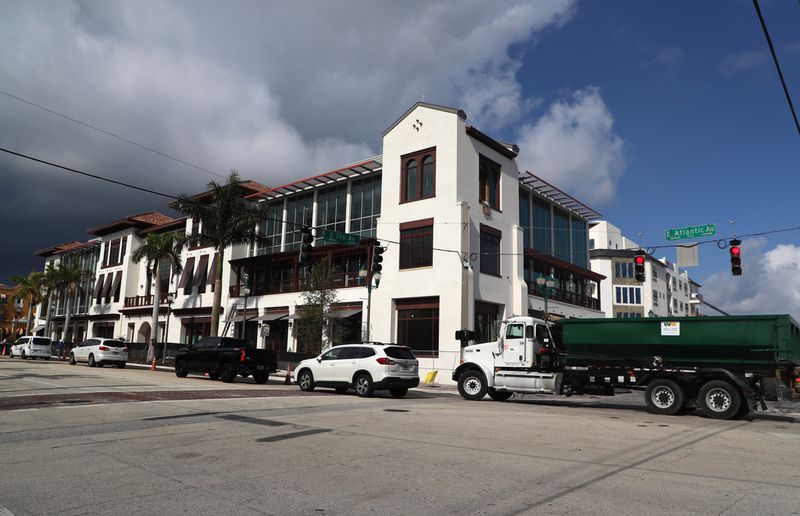
The building that will house the Bounce Sporting Club on East Atlantic Avenue in Delray Beach on Friday December 10, 2021. The $300 million Atlantic Crossing project has generated pushback. Some city officials and residents have expressed concerns the sports bar is out of character for the area and that noise from the late night establishment would be a nuisance to residents (Carline Jean / South Florida Sun Sentinel)

“I know there’s a great concern from the community there’s going to be lines out the door and that all these people are going to be drunk, unruly and noisy and that it’s going to be 1 a.m. and they’re still trying to get in,” Schiller said. “That’s not the case.

“We don’t want our guests to be lined up out the door on Atlantic Avenue. We’re trying to start an upscale sports bar, restaurant and lounge. Upscale places don’t let their guests, especially in Florida, wait in 90-degree heat to come in.”

Schiller said Bounce is willing to make concessions in order for later operating hours, including closing their doors, windows and patio at 11 p.m. and limiting people to one entrance and exit closest to Atlantic and 7th.

Bounce Sporting Club bills itself as combining “elements of a sports bar with the high-end cocktail lounge nightlife experience.” A representative for Bounce, which has additional locations in New York and Chicago, told city officials it would also feature live performances at the Delray Beach location.

Bounce has residential communities both to the north and south, extending east to the Intracoastal. In addition, the Atlantic Crossing complex also will feature 261 luxury apartments by the sports bar.

Some nearby residents, however, fear that allowing Bounce an exemption could create a domino effect where other bars outside the entertainment district would be granted later hours. Rita Rana, who sits on the board of Barr Terrace Condominiums across the Intracoastal from Bounce, said residents aren’t opposed to Bounce, but the potential of them operating past midnight and creating a situation where late-night revelry and noise could potentially cause issues.

“If this were to be approved, it would bust the boundaries of that entertainment district,” Rana said. “And it would change the entire dynamic of an area that has been slated not to have any of that entertainment past midnight.”

While Bounce officials are trying to assuage the fears of nearby residents, Rana said “prior to opening, there is absolutely nothing they could say and nothing they could do” to convince her they should be allowed to stay open until 2 a.m, adding that residents are still “fired up” about the matter.

Schiller believes some of the concerns are being overblown, arguing that some bars outside the entertainment district, such as Hurricane Bar & Lounge and Blue Anchor Pub, are allowed to stay open until 2 a.m. since they were grandfathered in before the boundaries were set.

Bounce is aiming to go before the city commission at some point in the spring, Schiller said. When asked whether Bounce would still open if it was denied the exemption, Schiller said it wasn’t something he could answer, but noted that investors were under the expectation the bar would be allowed to stay open until 2 a.m.

If there’s still heavy pushback, he said there could be the potential for compromise “if they want us to open until 1 a.m. for a period of time and then give us a chance to prove ourselves to get to 2, that’s something we may be in favor of.”

Link: As a luxury sports bar seeks later hours in Delray Beach, it gets caught in noise battle with neighbors
Auther: Wells Dusenbury

Rise Of Florida Mini-Cities Blurring Urban-Suburban Lines

Among outgrowths of the pandemic has been an explosion of newcomers to Florida. Many recent arrivals to the state are from urban areas in the Northeast and Midwest U.S., where density and walkability have long been part and parcel of daily life.

It’s only appropriate, then, that Florida is witnessing a surge in what might be termed “mini-cities.” These compact urban districts offer a dense, lively, pedestrian-friendly lifestyle fueled by proximity of homes, offices, eateries, shops and nightlife. They’re not that different from areas of New York City, Washington, D.C., Boston and Chicago where many folks get around to everything they need, all without vehicles.

The result is a blurring of the traditional demarcation between city and suburbia in some areas of Florida, where new development has replaced once-blighted landscapes.

Sense of place

Building mixed-use developments in Florida is not a new idea, says Gerard Yetming, executive managing director with Colliers. But the last half decade has ushered in a fresh concept: Creation of large-scale mixed-use areas intended to forge a sense of place in settings once devoid of housing and businesses. “It is clear people want to work and play where they live, which is why we will continue to see developers bringing urban designs to the suburbs, and suburban designs to urban cores,” he says.

Mixed-use developments from Fort Lauderdale-based master developer BTI Partners in Tampa’s Westshore Marina District and Hollywood, Fla.’s Hollywood Young Circle are two fitting examples of the phenomenon. Company CEO Noah Breakstone says the goal is to reimagine the way people live and invent fresh concepts that interweave healthy living, culture, technology, entertainment and work-life balance.

“To be able to achieve this goal, we blend the suburban-urban concepts in creating a new, redefined, walkable, mixed-use lifestyle,” Breakstone says.

Another instance of urban-suburban blurring has taken shape in Miam’s Wynwood enclave. Addition of an office component was the final piece of the puzzle necessary to make Wynwood a mini city, says Shelby Rosenberg, R&B Realty Group head of development and acquisitions, asset and property manager, U.S. portfolio. As it has for some time, the district has continued to serve up key redevelopment opportunities to transform long-abandoned industrial structures into Class A office buildings, chic eateries, upscale condominiums and attention-getting apartment communities.

New York City-based R&B Realty Group’s just-completed office tower Gateway at Wynwood helped trigger other developers to build market-rate apartments, luxury condos and stores. “In the next couple of years, as new projects are completed, people will be able to live, work and play in this area, which is becoming a city within a city,” Rosenberg says.

Replacing neglect

Coralee Penabad, principal at Coral Gables, Fla.-based Urban-X Group, reports that in constructing a mini-city west of downtown Miami, her company sought to become a driver of transformation in an area that for decades had seen only disinvestment.

“We were able to attract big-box retailers, which are often found in the suburbs, to the urban core because retailers recognize people are increasingly choosing to shop where they work and live,” she says. “This generation doesn’t want to drive to the suburbs to do their shopping. They are all about enjoying the benefits of the urban and suburban lifestyle in one submarket, without having to leave their neighborhood.”

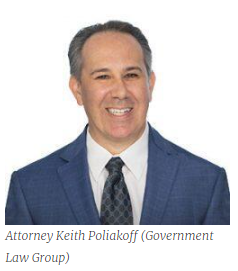
One more observer taking note of the mini-cities trend is land-use attorney Keith Poliakoff, founding partner of Fort Lauderdale-headquartered Government Law Group. Poliakoff says well-conceived developments are melding multiple uses to create urban environments in the suburbs, and vice versa.

He credits the leadership and long-term vision of elected officials intent on enhancing the quality of their constituents’ lives. Concludes Poliakoff: “A lot of community planning goes into these large-scale developments so that they can create live-work-play environments where residents never need leave the comforts of their mini-cities.”

Link: Rise Of Florida Mini-Cities Blurring Urban-Suburban Lines
Auther: Jeffrey Steele

A new sports bar in Delray Beach wants to stay open until 2 a.m. Here is why it’s raising major concerns among residents.

DELRAY BEACH — Delray Beach has long confined the festiveness from its late-night bars and restaurants to a half-mile stretch on Atlantic Avenue, but that could come to an end.

Bounce Sporting Club, an upscale sports bar set for the $300 million Atlantic Crossing development on Atlantic just east of Federal Highway, is hoping to become a new destination site on the Ave. The bar, however, sits outside the city’s entertainment district, which runs from Swinton to Federal Highway and allows businesses to stay open until 2 a.m.

They want an exception to the rule so they can show late-night sporting events such as UFC, boxing and West Coast sports. But city officials and residents have voiced concerns the late-night noise could become a nuisance to the people who live nearby and add “further degradation” to the area.

The surrounding neighborhoods near the Intracoastal Waterway “are precious in the city and they’re under a lot of assault from noise pollution, light pollution, overdevelopment,” Delray Beach Planning and Zoning Board member Joy Howell said during a public meeting.

“I think we should avoid further degradation of the district.”

Officials, who are considering the proposal, fear it could set precedent and create a “domino effect” where restaurants and bars outside the entertainment district could push to remain open until 2 a.m.

Bounce Sporting Club bills itself as combining “elements of a sports bar with the high-end cocktail lounge nightlife experience.” A representative for Bounce, which has additional locations in New York and Chicago, told city officials it would also feature live performances at the Delray Beach location.

Bounce has residential communities both to the north and south, extending east to the Intracoastal. In addition, the Atlantic Crossing complex also will feature 261 luxury apartments by the sports bar.

Claudia Willis, a 25-year Delray Beach resident who lives in the neighborhood 300 feet south of the sports bar, spoke against the late-night hours during a public meeting, saying the applicants don’t fully grasp how much bothersome the noise could be.

She talked of how easily noise travels across the downtown, saying she can “hear every word when there’s an outdoor performance at Old School Square,” which is a half-mile west. “Unless you live downtown, you don’t know.”

“The applicant chooses to ignore us to the south, but also ignores their own [apartments],” Willis said.

The city “needs to decide what kind of town Delray will be and guide that in every decision. It is subtle decisions that are changing our demographics. Many have already left in search of what Delray used to be.”

Atlantic Crossing, a massive 9-acre project by Veterans Park and the Intracoastal Waterway, is the city’s attempt to invigorate the stretch of Atlantic east of Federal, which has remained largely dormant.

The site will also feature restaurants, shops and 83,000 square feet of office space. Construction is projected to be finished by the end of the year, a spokeswoman for the development said.

Bounce Sporting Club, a 5,000-square-foot venue, is one of the cornerstones of the project, operating on the first floor off Atlantic Avenue. Michael Dutko, a representative for Bounce, told the Delray Beach Planning and Zoning Board that Bounce would be an “incredibly valuable addition” to Atlantic, citing the lack of high-end sports bars. He also said noise wouldn’t be an issue, pointing to design measures created to limit noise.

Chris Davey, Chairman of the Planning and Zoning Board, was unconvinced, however. “This isn’t the city that doesn’t sleep and it’s not the Windy City,” he said, referencing Bounce’s other locations in New York and Chicago.

Davey, along with board member Rob Long, also worried that allowing a 2 a.m. exception could set a precedent where other bars and restaurants do the same, creating a possibility for late-night establishments to creep closer and closer to residential areas.

Keith Poliakoff, a Fort Lauderdale attorney who specializes in land use and zoning issues, said a one-time exception wouldn’t create a “strong legal grounds” if a future applicant was denied on a similar proposal.

“Every applicant stands on its own merits,” Poliakoff said. “If they approve this one and deny another one, there’s no strong legal grounds for them to sue a municipality based on that decision. For the same reasons a municipality could oppose two schools going next to each other or two houses of worship.”

Poliakoff said the board is likely referring to precedent in terms of “‘will that create an idea with the community that we’re turning this into an entertainment district as well?’”

Dutko appeared surprised by the pushback from board, saying he didn’t “anticipate it being controversial.” He argued that some bars outside the entertainment district, such as Hurricane Bar & Lounge and Blue Anchor Pub, are allowed to stay open until 2 a.m., but Davey noted those bars were grandfathered in before the boundaries were set.

Bounce representatives plan on revising the proposal to address the noise complaints in an attempt to salvage the late-night hours. The Planning & Zoning Board will issue a final ruling on the proposal during an upcoming meeting.

Link: A new sports bar in Delray Beach wants to stay open until 2 a.m. Here is why it’s raising major concerns among residents.
Auther: WELLS DUSENBURY

South Florida Business Journal Runs Jordan Announcements

South Florida elected leader worked remotely during COVID. His peers determined whether he could keep his commission seat

MIRAMAR — Miramar City Commissioner Winston F. Barnes, 73, will keep his seat on the dais.

City leaders planned to vote at Monday night’s meeting on whether to oust Barnes for attending commission meetings remotely throughout the pandemic. But before any commissioners could discuss or vote, Commissioner Maxwell Chambers, who brought up the motion, withdrew it.

Barnes had filed a motion to fire City Attorney Burnadette Norris-Weeks and the firm she represents, Austin Pamies Norris Weeks Powell, PLLC. She, too, will get to keep her job, commissioners decided.

After the hours-long heated discussion and public comment surrounding Barnes’ and the city attorney’s potential terminations, commissioners largely agreed that they wouldn’t support losing either person.

Mayor Wayne Messam said Monday’s meeting was “one of the darkest” he had seen in his 10 years on the job. Messam said he was surprised to see the topic on Monday’s agenda because no commissioner supported taking action on Barnes’ potential firing at the last meeting.

He couldn’t support removing Barnes, Messam said, pointing out that the agenda item made it seem as if he “has been absent, void, silent, AWOL for one year” when Barnes was still attending the meetings and voting on items. He told commissioners he was not in favor of removing the city attorney, either.

“There obviously is not support for the removal of our attorney, but I must say that I don’t know how this wound can be mended, but there has to be some way that it’s addressed,” Messam said. “It has to be.”

After Barnes had attended meetings virtually from May 20, 2020, through September of this year, commissioners asked Norris-Weeks for her legal input on whether a commissioner was obligated to attend meetings in person and if he or she could be in attendance without physically being there.
Norris-Weeks issued a memo that says if the mayor or commissioner does not attend meetings for three consecutive months, he or she can be “relieved” of office by the commission’s majority vote.

Barnes, 73, who was elected in 2003, “emotionally shared his medical conditions” at an October meeting and told his colleagues that a family member of his had been hospitalized and remains in a coma, a letter from Barnes’ attorney, Keith Poliakoff, to City Attorney Burnadette Norris-Weeks says. Barnes recently returned to attending the meetings in person.
Poliakoff’s letter to Norris-Weeks notes that Barnes was marked “present” in the minutes for each meeting he logged into from May 20, 2020, through Sept. 1 of this year and that Barnes was never told he may be violating the city charter for attending and participating virtually.

Barnes said Monday that the city attorney “literally set me up” by not telling him about his needing to physically be in the chambers. “The taxpayers and the city of Miramar deserves better than it is getting with our city attorneys,” he said.

He defended himself from some who have brought up that he has been going to work in person at the radio station where he works. “I sit in a booth by myself, and on top of that we are such a small operation if at any time there are five people in the building, we are overcrowded,” he said. “When I left work today, there were two other people in the building.”

Before removing his motion to fire Barnes, Chambers said he felt staff made their best efforts to provide a safe environment at the chambers for leaders to return during the pandemic with plexiglass shields and mask requirements. He proposed that commissioners in a future situation may create a rotating schedule for commissioners to decide who can work virtually and when to avoid the same issue.

“When you’re here to do the people’s business, you have to be responsible, that’s why we are here … We all came back, staff came back, and there’s no excuse,” Chambers said.

Commissioner Alexandra Davis said accusations that the discussion to fire Barnes was political retribution was “quite maddening.”

“It’s very clear what the charter states — that we needed to have shown up for work,” Davis said. “All of that being said, we agree to move on from this as a lesson learned and that hopefully in the future [if] any one of us have an issue coming to work, we’ll let our colleagues know …””

Barnes’ motion to fire the city attorney argued that the commission had “lost faith in the Norris-Weeks ability” to provide legal counsel in the best interest of Miramar citizens. No one supported Barnes’ motion.

Vice Mayor Yvette Colbourne said she could not support removing the city attorney “based on what one commissioner feels has been one wrong incident.”

“That’s now how you judge someone’s performance. I think when we have an issue it needs to be worked on, it needs to be resolved,” Colbourne said. “We need to be reasonable, and we need to approach these things both as adults and as professionals.”

Michelle Austin Pamies, a partner at Austin Pamies Norris Weeks Powell, PLLC, said the opinion provided to city leaders about Barnes’ attendance and participation was the best, most accurate opinion the city attorney could provide.

“When a commissioner comes to you and asks for a legal opinion on any matter, you provide the opinion you think is accurate. We are not advising the city commission to take action. We’re asked to provide an opinion,” Austin Pamies said.

Link: South Florida elected leader worked remotely during COVID. His peers determined whether he could keep his commission seat
Auther: ANGIE DIMICHELE

This elected leader worked remotely during COVID. Now he may get fired.

MIRAMAR — A 73-year-old elected official who worried about contracting COVID-19 faces losing his job — because he only showed up virtually for business during the pandemic.

Miramar city leaders are expected to vote Monday whether to fire Commissioner Winston F. Barnes, concluding that leaders “may punish its own members for misconduct,” according to the city’s documents.

Officials said he can be fired because he broke the city’s rules by not attending commission meetings in person for three months.

There’s a battle to come: Barnes’ lawyer, Keith Poliakoff, says the city has no authority to oust him. It’s the voters who put Barnes in office, not his fellow elected officials. And only Florida’s governor has the power to remove an elected official from office, the lawyer says.

Was it misconduct?

The commission, which resumed in-person meetings last year, asked City Attorney Burnadette Norris-Weeks for her legal opinion last month. They wanted to know “whether there is an obligation of City Commissioners to attend city commission meetings in person,” and whether they could be in attendance without being physically present.

She issued a memo indicating that the charter reads that if any member “shall fail to attend meetings for a consecutive period of three months,” then that person “may be relieved of his/her office by a majority vote of the City Commission.”

She told the South Florida Sun Sentinel it’s “illogical” to think somebody could attend remotely indefinitely and not return in person. An in-person quorum is required to even have a meeting, she said. If people thought they could work remotely forever, they would, she said. “Everybody was afraid,” she said of the pandemic. “Nobody was sitting around thinking they didn’t have to come back.”

Commissioner Alexandra Davis said she doesn’t favor firing Barnes, but still notes it’s important to attend meetings in person. “I believe he’s elected by the people but at the same time he has to do his job and show up to work,” Davis said. “The people deserve [for] him to show up.”

Attending meetings virtually

Barnes said he has participated: He started attending meetings online when COVID-19 closed City Hall. He has recently returned to appearing in person.

Poliakoff argues that Barnes attended virtually from May 20, 2020, through September of this year and that the city’s attorney “suddenly and surprisingly completely reversed course and now opined that participation is not the same as attendance.”

He wrote in a memo to Norris-Weeks that she needs to reverse her legal decision.

Poliakoff said because of Barnes’ age, 73, and existing medical issues, he’s considered high-risk and was being careful to not contract the deadly virus while still attending City Hall meetings.

Barnes said other members of the commission have had COVID or had to be quarantined, and he wanted to make sure he didn’t bring anything home to his family.

Barnes said he believes the push to fire him is political retribution: He often has conflicting votes with his colleagues, and he also supported Broward County Commissioner Barbara Sharief in South Florida’s recent 20th Congressional District race.

Many of his other colleagues, who are of Jamaican descent, supported another candidate, Jamaican-born Dale Holness. One of Holness’ supporters is City Commissioner Maxwell Chambers — Sharief’s ex.

“I vote my conscious,” Barnes said. “I can vote freely.”

When he did miss a meeting entirely, he said it was days after his wife’s sister was in a car crash that left her in coma. He said he has only missed a couple meetings in his entire tenure at City Hall.

Barnes has turned the tables: Also up for discussion Monday is his motion to fire the city’s attorney, saying she never told Barnes that anything was amiss.

“At every meeting he was marked as present, his vote was counted,” Poliakoff said. “At no time was he ever told, ‘You need to be in person or we’re not going to consider you present.’”

If the commission were to remove Barnes, he’ll file an injunction and the legal fees will start mounting, Poliakoff said. “They have no authority to throw him out of office,” he said. “They’re doing it just to see if they can get away with it, really.”

Link: This elected leader worked remotely during COVID. Now he may get fired.
Auther: LISA J. HURIASH and BRITTANY WALLMAN

South Florida expects windfall from $1.2T infrastructure bill

The $1.2 trillion infrastructure bill Congress passed is expected to jump-start major construction projects in South Florida, bringing a significant number of jobs and opportunities for local contractors.

The Infrastructure Investment and Jobs Act, which President Joe Biden is expected to sign in the coming days, includes multiple areas of infrastructure that will be bolstered nationwide.

Miami-Dade County Mayor Daniella Levine Cava said her administration has been preparing to partner with the federal government to invest whatever money comes its way into “hundreds of shovel-ready resilience projects that also create good-paying local jobs.”

“We’re ready to put these funds to work to create new opportunities for thousands of Miami-Dade residents and businesses as we build back our economy stronger than ever,” she said in a statement.

Levine Cava’s office highlighted numerous projects it expects will be near the front of the line for federal stimulus, such as converting septic systems to sewers; allowing ships at PortMiami to hook up to shore power instead of burning fuel; building more electric vehicle chargers; and climate resilience projects such as roadway improvements, floodwater mitigation and the protection of wastewater treatment plants to guard against climate change. The county’s SMART Plan for mass transit will also be a priority. Its mass transit corridors include bus rapid transit routes from Dadeland to Florida City and the Miami Intermodal Center near Miami International Airport to Tamiami, and a commuter train on the FEC Railway from Miami through Aventura.

Lisa Colon, a construction attorney at Saul Ewing Arnstein & Lehr in Miami, said the bill will create many jobs in highways and bridge construction, as well as public transportation and climate infrastructure. Miami-Dade was under pressure from regulators to reduce pollution from its wastewater system, so this bill should provide funding to help it modernize its system, she said. The county has been considering working with private companies to fund the repairs to the Rickenbacker Causeway, which leads to Key Biscayne, but the bill may provide enough funding to start the project, Colon said.

The infrastructure bill also has a 10% target for small businesses participating in these construction projects, and includes outreach and training funds for small businesses and disadvantaged businesses, which generally includes minority- and women-owned contractors, she said.

Colon said to make sure to register with the SBA as a small disadvantaged business “because they will favor these programs toward them.”

Dan Lindblade, CEO of the Greater Fort Lauderdale Chamber of Commerce, said the influx of federal money could bring 700 to 2,000 new jobs to Broward County.

“The reason it’s important for us is bridges, roads, subterranean infrastructure,” he said. “This is a real godsend for South Florida – and for the United States, for that matter.”

Broward Mayor Steve Geller said his county has substantial needs when it comes to making itself more resilient to sea level rise and climate change.

“We are currently 2 inches from overtopping the … flood control structures,” he said. “I am truly worried that we are going to be flooded in South Florida.”

The federal money will also be a huge help for Broward’s efforts to improve its transportation system, including roads, buses, highways, rail, Port Everglades and Fort Lauderdale-Hollywood International Airport.

Gretchen Cassini, Broward’s Mobility Advancement Program administrator, said the county will be able leverage its recently passed sales tax for matching grant funds from the federal government. In March 2018, Broward voters approved an additional 1% sales tax for transportation and mobility improvements. It is expected to bring the county $16 billion over 30 years.

“The importance of the surtax is that we have become more competitive for all of these various grant programs because we have a local dedicated source of revenue,” she said.

Federal funding may also be tapped for one particularly important and huge project: creating a new way for passenger trains to travel over the New River in Fort Lauderdale. Grupo México-owned Florida East Coast Railway freight trains and Brightline passenger trains, owned by Tokyo-based SoftBank Group Corp., use the Florida East Coast Railway Bridge, a drawbridge that is only 4 feet above the water. Whenever the bridge goes down, boat traffic is interrupted, sometimes for as long as 45 minutes. That happened 34 times a day prior to the pandemic, much to the frustration of the local marine industry.

Additionally, Tri-Rail Coastal Link, a proposed commuter train service operated by the South Florida Regional Transportation Authority, won’t be able to operate north of the the New River since Grupo México, which also owns the train tracks, capped the number of trains traveling over the bridge at 36 trips a day. The commuter service, which is still not fully funded and depends on cooperation from Brightline and the FEC, is envisioned to have 81 stops between downtown Miami and Jupiter.

Proposals for a new passenger rail connector include building a bridge at least 25 feet above the water and a tunnel under the river. Those proposals, which cost from $216 million to $2.5 billion, will be discussed at a Nov. 18 meeting in Fort Lauderdale.

Neil Schiller, an attorney and lobbyist affiliated with Boca Raton-based Government Law Group, said Palm Beach County officials are likely “salivating” over the prospect of receiving hundreds of millions of dollars for infrastructure improvements. He noted that the county has already aggressively invested taxpayer money toward improving and upgrading roadways and bridge. Now, with federal money earmarked for such purposes, Schiller said local tax money might be diverted for other purposes, “things like homeless workforce housing and affordable housing.”

Donald Burgess, CEO of the Chamber of Commerce of the Palm Beaches, said he’d like to see the money used to improve drainage in coastal cities and road connections between the eastern and western parts of the county.

“We are fine with the north-south flow of traffic,” he said, “but when it comes to the east-west, that has always been a challenge.”

As for the economic impact, Burgess said it’s too early to tell.

“It is a big deal, but right now, in terms of the business community, it is very hard to say what the impact is going to be,” he said. “Yes, it has been approved, but we are not sure as yet of the details of what the state will get, what counties will get, what the cities will get.”

Link: South Florida expects windfall from $1.2T infrastructure bill
Auther: Brian Bandell and Erik Bojnansky

Movers & Influencers

Government Law Group, Fort Lauderdale

Attorney Payton H. Poliakoff has joined Government Law Group as an Associate. Government Law Group is a boutique firm that provides clients with a comprehensive 360-degree approach for government and litigation solutions. Mr. Poliakoff will focus his practice on complex commercial litigation and government contracting.

Government Law Group, Fort Lauderdale

Attorney and City of Parkland Commissioner Jordan B. Isrow has joined Government Law Group as a Partner. Government Law Group is a boutique firm that provides clients with a comprehensive approach for government, litigation, and business solutions. Mr. Isrow will focus his practice on complex litigation, corporate counseling and representation of municipalities.

Article Link: Movers & Influencers

South Florida Business Journal Runs Jordan and Payton’s Announcements

NEW HIRE LEGAL SERVICES NOVEMBER 4, 2021

Jordan Isrow

Partner at Government Law Group

https://www.govlawgroup.com/

EDUCATION:  University of Miami (Coral Gables, FL)

Attorney and City of Parkland Commissioner Jordan B. Isrow has joined Government Law Group as a Partner. Government Law Group is a boutique firm that provides clients with a comprehensive approach for government, litigation, and business solutions. Mr. Isrow will focus his practice on complex litigation, corporate counseling and representation of municipalities.

NEW HIRE LEGAL SERVICES NOVEMBER 4, 2021

Payton Poliakoff

Associate at Government Law Group

https://www.govlawgroup.com/

EDUCATION: University of Miami (Coral Gables, FL)

Attorney Payton H. Poliakoff has joined Government Law Group as an Associate. Government Law Group is a boutique firm that provides clients with a comprehensive 360-degree approach for government and litigation solutions. Mr. Poliakoff will focus his practice on complex commercial litigation and government contracting.

Article Link: South Florida Business Journal Runs Jordan and Payton’s Announcements

New lease on life: Apartment projects popping up at distressed South Florida shopping centers

A rendering of Terra’s CentroCity development with David Martin of Terra

Multifamily developers want sites in walkable places, and struggling shopping centers need to fill vacant spaces

Residential redevelopment of South Florida shopping centers is becoming more common, amid solid demand for rental housing and a slack market for retail space.

This month, Houston-based developer Morgan Group won a land use change to build 356 apartments on the site of a former Macy’s store and parking lot at Pompano Citi Centre, a shopping center in Pompano Beach on the southwest corner of Copans Road and Federal Highway.

“We haven’t seen many of these residential transformations at commercial centers, but I think you’ll start to see more of them as the centers unfortunately start losing tenants on a permanent basis,” said attorney Neil Schiller, a founder and shareholder of Boca Raton-based Government Law Group who represents real estate developers.

Shopping centers in densely populated areas are among the best in-fill sites for multifamily developments because they can meet the residential, occupational, and recreational needs of residents, said Art Falcone, co-founder and chief investment officer of Boca Raton-based Encore Capital Management.

“As South Florida gets basically built out, the opportunity now is combining live, work and play,” Falcone said. “People don’t like to be in cars and stuck in traffic.”

Plantation Walk

Falcone’s company acquired the 34-acre Fashion Mall in Plantation, demolished it, and is replacing it with Plantation Walk, a mixed-use redevelopment that ultimately will include 730 apartments. Tenants have started moving into two newly opened apartment buildings with 410 units, and Falcone expects construction of a third apartment building with 320 units to start early next year.

Falcone said Encore also has received certificates of occupancy for 130,000 square feet of new retail and restaurant space. Other completed projects at Plantation Walk include a Sheraton Suites hotel and a fully leased, 180,000-square-foot office building where insurance giant Aetna occupies half the space.

Newer mixed-use developments in South Florida commonly combine commercial space and rental apartments. Miami-based Terra developed Pines City Center in Pembroke Pines from the ground up with more than 300,000 square feet of retail and restaurant space and 400 apartments.

A positive market response to the residential options at Pines City Center encouraged Terra to acquire a 38-acre shopping center in Miami called Central Shopping Plaza, renovate the existing stores, including a former Kmart store that Target will occupy, and build apartments around them.

A rendering of Terra’s CentroCity development

The first phase of that redevelopment, called CentroCity, will include 460 apartments, and will be completed in 12 to 18 months, said David Martin, CEO of Terra. By 2024, he said, Terra plans to build a total of 1,100 apartments and 250,000 square feet of office space at the CentroCity property in Miami’s West Little Havana neighborhood.

At Pines City Center, “what we saw was a very strong symbiotic relationship. Residents loved living around a retail offering, and retailers liked having customers who can walk to the store,” Martin said. “It becomes a lifestyle offering for the residents and obviously increases the number of repeat customers” for the retail tenants.

Another large-scale redevelopment is expected to bring a residential component to the Boynton Beach Mall. Columbus, Ohio-based Washington Prime Group won a rezoning of the 108-acre mall in Boynton Beach for a redevelopment that would combine as many as 1,420 apartments and up to 400 hotel rooms with 629,000 square feet of retail space. Washington Prime Group recently emerged from Chapter 11 bankruptcy with a new CEO.

However, shopping center owners like Beth Azor are unlikely to redevelop their properties in the absence of low occupancy rates. Azor is founder and principal of Azor Advisory Services, a Weston-based company that owns six shopping centers in Broward County.

She has no plans for multifamily development at any of her shopping centers because they aren’t distressed – three are fully leased – and because developers are building hundreds of apartments near her centers in Davie, Plantation and Sunrise.

“There are so many wiser, more experienced, richer folks doing apartments, that I like to watch their success from my vantage point,” she said, citing her career as an investor in shopping centers. “After 35 years in the business, I know how to do those, versus trying to learn how to develop multifamily properties.”

Link: New lease on life: Apartment projects popping up at distressed South Florida shopping centers
Auther: Mike Seemuth